

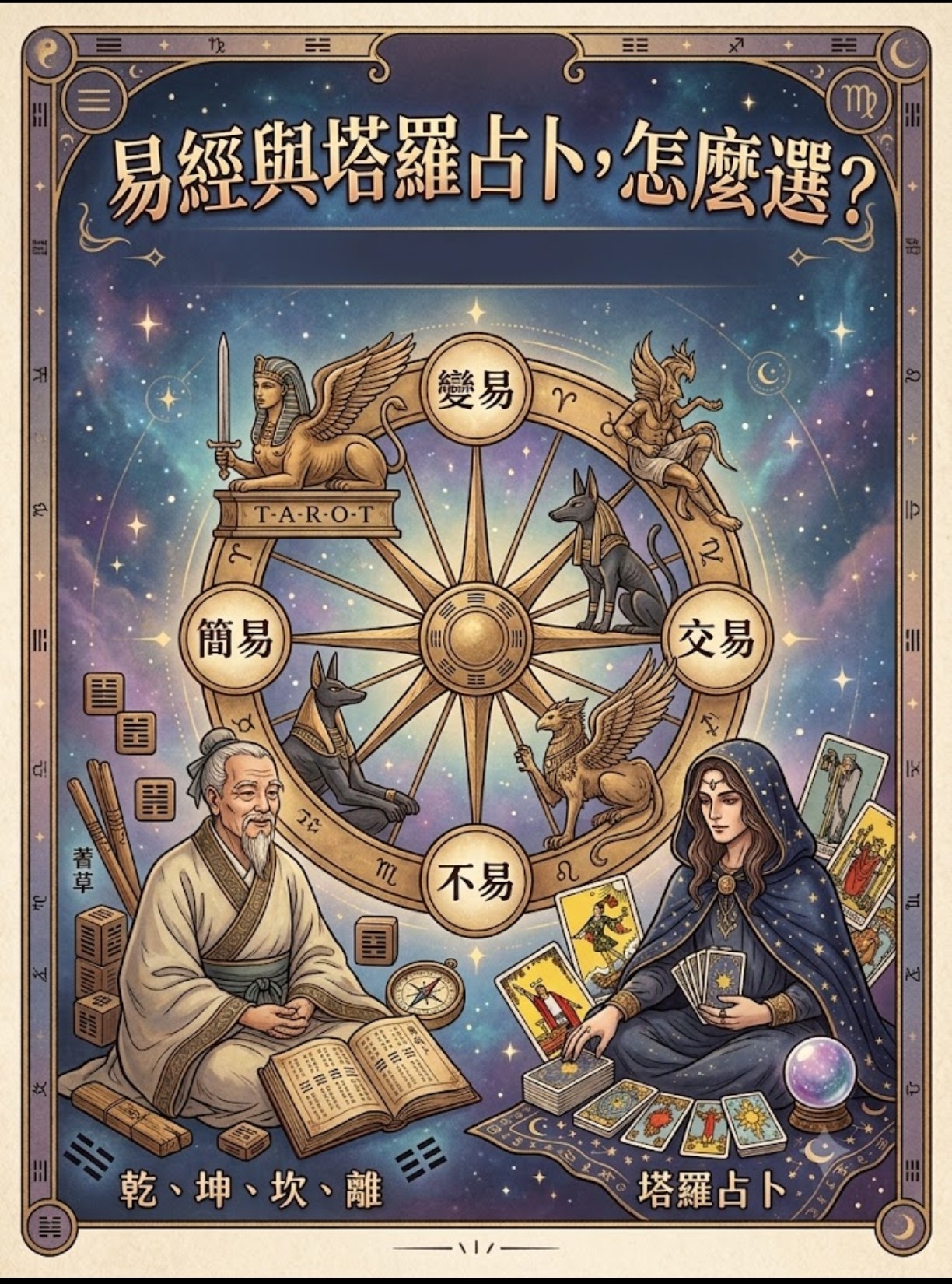
As I mentioned in my previous post, "Fortune Telling vs. Divination: Which to Choose?", when you have a dilemma: If the matter is mainly under your control, you should consult a fortune teller. If the matter involves several people or a broader environment, and is mainly beyond your control, you should use divination. The next question is, in terms of divination, both the I Ching and Tarot are mainstream and profound, so how do you choose between them? Simply put, the I Ching, this "set of answers," talks about "the beginning, development, transition, and conclusion of events, the shift in trends, and the change in public sentiment." Because the content of the I Ching is originally the history of the Zhou's conquest of the Shang (the prototype of the Investiture of the Gods story), it can be directly applied to cooperation, the rise and fall of organizations, personal career paths, and personal luck. If marriage is viewed as "a cooperation in life," it can also be applied. As for matters of the heart, it's best to "forget about it." Tarot cards, besides the definitions of the cards themselves, also have images on them that are part of the answer. The images offer much more room for association than the I Ching. Therefore, Tarot readings, when performed with the client in person, test the Tarot reader's intuition and imagination, enabling them to interpret many personal and emotional matters. If the client is not present, Tarot is not necessarily superior to the I Ching. That is to say, for personal questions, Tarot is far superior to the I Ching in person. For business matters and matters of interest, the I Ching is better. In recent years, some have interpreted "Tarot" as "image association," creating illustrated "I Ching Tarot" to regain some advantages in interpretation.
 10914天前
 艾石
艾石















Comments 0