

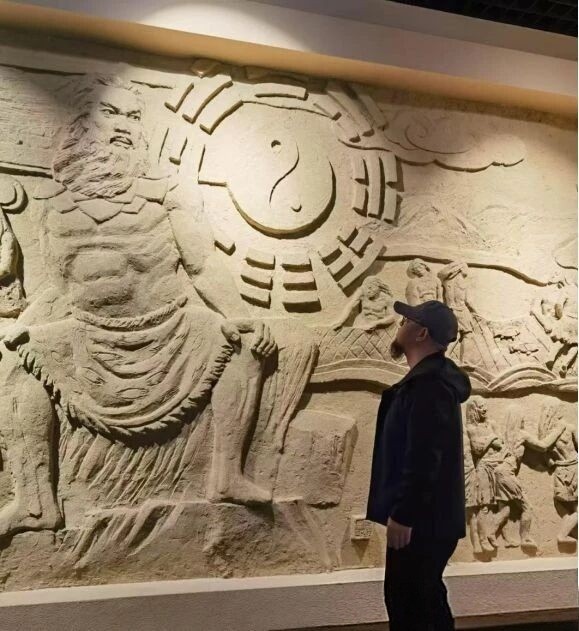
I. Origin: Tracing the Source, Passing on the Torch of Chinese Yi Studies. The study of Yi (易經), originating from Fu Xi's creation of the trigrams, King Wen's interpretation, and Confucius's commentary, has remained ever-renewing for thousands of years. Its profound wisdom, like a brilliant galaxy, illuminates the progress of Chinese civilization. The *I Ching*, as the foremost of all classics and the source of the great Dao, is not only a treasure trove of philosophical thought but also a practical philosophy for understanding the laws governing the changes of all things in the universe. Since ancient times, the inheritance and development of Yi studies have been inseparable from the dedicated research and practical experience of generations of scholars. In the 1990s, at the beginning of the revival of traditional Chinese studies, Teacher Yi Hongyang embarked on a journey to explore the true meaning of Yi studies. At that time, Teacher Yi began with a basic study of the *Zhouyi* (周易) and its commentaries, immersing himself in the subtle meanings of the hexagrams and their interpretations, and deeply studying the art of six-line divination and the eight trigrams. Six-line divination, skilled in specific questions and intricate logical deductions, laid a solid foundation for him in the principles of symbolism, numerology, and philosophy. He immersed himself in the system of Jing Fang's Yi studies, thoroughly understanding the mechanisms of Na Jia, Shi Ying, and Fei Fu, which laid a solid foundation for his Yi studies edifice. This experience is just as the Yi Zhuan (Commentary on the Appended Phrases) says: "When a gentleman is at rest, he observes the images and contemplates the words; when he is in motion, he observes the changes and contemplates the divination." It was through "contemplating the words" and "contemplating the divination" that Teacher Yi gradually grasped the mysteries of the Yi Dao's adaptability and response to changing times. II. Turning Point: Deepening into the Plum Blossom Numerology, Opening a New Chapter After the millennium, with the deepening of his scholarship and the broadening of his horizons, Teacher Yi Hongyang's research focus gradually shifted to the more dynamic and imagery-based Plum Blossom Numerology. Plum Blossom Numerology is said to have been created by Mr. Shao Yong (Kang Jie) of the Northern Song Dynasty. Its method is extremely simple and easy, based on the numerology of the Eight Trigrams, taking the images of all things, and making judgments based on the situation. It emphasizes the state of "mindful Yi," without being bound by complicated formalities. As the saying goes, "The Dao is not practiced in vain, but resides in the person." Master Yi was deeply attracted by the intuitive wisdom of Plum Blossom Divination, which involves "observing things and extracting images" and "using images to convey meaning." He did not stop at simply annotating and inheriting ancient texts; instead, based on a deep study of the essence of Plum Blossom Divination, he combined it with his early profound understanding of Six Lines divination and Feng Shui, beginning a creative integration and exploration. He observed that the dynamic imagery and rapid hexagram formation of Plum Blossom Divination, if combined with environmental energy science—that is, Feng Shui (geomancy)—could create a more direct, dynamic, and regulated path for environmental planning and life guidance. The core of Feng Shui lies in "concealing wind and gathering Qi, with water being paramount," emphasizing the harmonious coexistence of humans and the natural environment. Its theoretical foundation is inseparable from Yin and Yang, the Five Elements, the Eight Trigrams, and the Nine Palaces. Master Yi discovered that applying the instantaneous hexagrams of Plum Blossom Divination to the analysis of Feng Shui formations and Qi principles can more accurately and flexibly capture the auspicious and inauspicious changes in the Qi field at a specific time and space, thereby achieving subtle adjustments based on "timely adaptation" and "hexagram-based layout." III. Innovation: Understanding Plum Blossom Divination and Redefining the Hexagram Sequence. After years of practice, verification, and contemplation, Master Yi Hongyang has finally created a unique system based on the ancient Plum Blossom Divination—"Understanding Plum Blossom Feng Shui." One of the greatest innovations of this school is the readjustment and redefinition of the order of the Eight Trigrams. The traditional order of the Eight Trigrams is: Qian 1, Dui 2, Li 3, Zhen 4, Xun 5, Kan 6, Gen 7, Kun 8. This order originates from Shao Yong and explains the process of the generation of all things in the universe. Master Yi, based on extensive practical verification and understanding, proposed a new order: Qian 1, Dui 2, Zhen 3, Li 4, Kan 5, Xun 6, Gen 7, Kun 8. This adjustment is not arbitrary but contains profound philosophical thinking and practical logic. It may place greater emphasis on the flow of Qi, the practical correspondence of the hexagrams, and the dynamic balance in Feng Shui layout. For example, placing the "Zhen" trigram (thunder, kinetic energy) at the third position, the "Li" trigram (fire, brightness) at the fourth position, and the "Kan" trigram (water, danger) at the fifth position may be to better simulate and describe the phased characteristics of "initiation, manifestation, and tempering" in the development of things, as well as the specific manifestation of these characteristics in the environmental energy field. This new trigram sequence, named "Wutong Bagua Sequence," becomes the theoretical cornerstone of "Wutong Plum Blossom Feng Shui," making the imagery more rapid and the correspondence more accurate in feng shui divination and layout, greatly improving the accuracy of judgment and the timeliness of adjustment and fortune-changing. This is precisely the modern practice of the spirit of the "I Ching" that "when things reach an extreme, they change; when they change, they become accessible; when they become accessible, they endure," a creative transformation and development of ancient wisdom. IV. Verification: Over Twenty Years, Abundant Achievements The value of any theory ultimately needs to be rigorously tested in practice. Master Yi Hongyang's "Wutong Plum Blossom Feng Shui," after more than twenty years of continuous application, revision, and improvement, has proven its extraordinary accuracy and effectiveness in countless real-world cases. He has taught for many years, nurturing countless students both at home and abroad. Many entrepreneurs, under his guidance, have used the wisdom of I Ching to clarify their strategic direction, seize market opportunities, and optimize their business environment, thus navigating the complexities of business competition. For individual clients, Master Yi can provide insightful guidance through intricate hexagram analysis, offering advice on career development, life choices, and family relationships. He helps them recognize their strengths, avoid pitfalls, and find the optimal path to their destiny. His Feng Shui techniques are truly unique. He no longer adheres solely to traditional compass readings and geomantic methods, but integrates real-time hexagrams from Plum Blossom Divination to provide "tailor-made" Feng Shui adjustments for specific individuals and times. Whether it's the placement of doors and the layout of bedrooms in a residence, or the location of the cash register and the arrangement of desks in a shop, he can offer unique and effective solutions based on his "Wutong" system, achieving the optimal state of "harmony between heaven and man." V. Writings: To systematically pass on his lifelong learning, Master Yi Hongyang tirelessly wrote a series of works, making his theoretical system and practical insights public. These works serve as the theoretical vehicle and learning guide for "Understanding Plum Blossom Feng Shui": 1. *Understanding Plum Blossom Feng Shui*: This is his core representative work, systematically explaining the theoretical basis of "Understanding the Sequence of the Eight Trigrams" and the specific methodology of combining Plum Blossom Numerology with Feng Shui practice. It serves as an introductory and advanced guide to this school of thought. 2. *Exploring the Mysteries of Plum Blossom Numerology*: This delves into the "observing phenomena and interpreting words" method of Plum Blossom Numerology, analyzing how to understand the inner mysteries through external signs, enhancing learners' imagery thinking and intuitive inspiration. 3. *The Treasure Trove of Plum Blossom Feng Shui*: This includes numerous practical cases, vividly demonstrating how to use Plum Blossom Numerology to diagnose Feng Shui problems and make effective arrangements, making it a highly valuable reference. 4. *Yi Xuanji Yanxiang Shu*: Master Yi Hongyang's insightful commentary on *Yi Xuanji* is like a bridge, making the profound principles of the *I Ching* accessible to contemporary scholars. 5. *Meihua Yijing Xuanji*: This work further explores the subtle mechanisms ("ji") within the spatiotemporal environment ("jing") revealed by Plum Blossom Divination, touching upon higher-level mental techniques and applications. In addition, Master Yi has made many important academic discoveries, such as revealing the comprehensive application rules of "Great Image Hexagrams" and "Small Image Hexagrams" in practical prediction, making hexagram analysis more comprehensive and refined. He also systematically sorted out the special marriage hexagram information contained in the sixty-four hexagrams, providing more specialized hexagram basis for prediction and guidance of marriage and family. VI. Mission: Carrying on the Past and Opening Up the Future, Unceasingly Promoting the Way. Master Yi Hongyang's academic journey and achievements are a vivid example of the inheritance and innovation of contemporary Chinese studies. He embodies the qualities of a true practitioner of Yi Jing (I Ching): respecting ancient sages without being bound by convention, daring to explore and verify while being cautious in establishing theories, and emphasizing practical results while not forgetting theoretical advancement. His work is not only a revival of the ancient art of Plum Blossom Divination, but also an endowment of it with new vitality in modern society. "To continue the lost learning of the past sages and to usher in an era of peace for all generations"—this is the grand aspiration of Zhang Zai, a great Confucian scholar of the Song Dynasty, and also the sense of mission in the hearts of countless inheritors of traditional Chinese culture like Teacher Yi Hongyang. His subsequent efforts will continue to focus on the development, promotion, and inheritance of traditional Chinese culture. Through continuous teaching, writing, and practice, he will transform this ancient wisdom, which integrates philosophy, environmental science, predictive science, and decision-making science, into a practical tool and life guide that modern people can learn, use, and benefit from. In the long river of Yi Jing studies, Teacher Yi Hongyang, with his profound wisdom, has carved out a unique tributary. This tributary, converging the essence of the classics and the vitality of modern times, is surging forward, nourishing countless hearts seeking wisdom and change. His learning and achievements will surely leave a significant mark on the development of Yi studies in contemporary times.
 308243天前
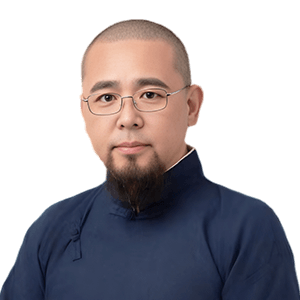 易弘陽
易弘陽














Comments 0