

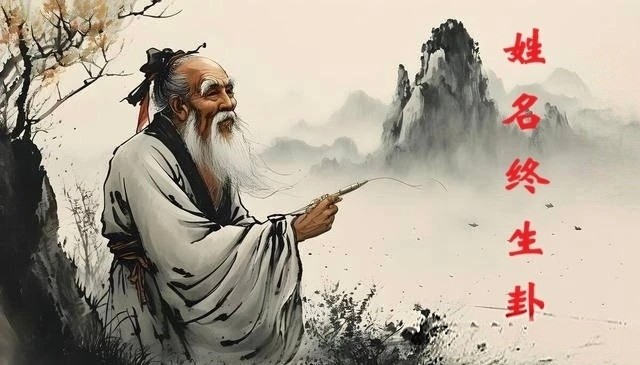
The Plum Blossom Divination's Lifelong Name Hexagram uses the name as the source of the hexagram and numerology as the basis for deduction, revealing the ups and downs of a person's life, including fortune, misfortune, and career. Its accuracy even surpasses that of the Eight Characters of Birth. While the Eight Characters of Birth represent one's innate destiny, the name is an acquired imprint; both are codes of life. However, the Lifelong Name Hexagram, with its unique principles, unravels the complexities of acquired information to depict the complete picture of fate, making it a truly exquisite form of divination. Plum Blossom Divination inherits the innate learning of Shao Yong, using "image, number, principle, and divination" as its core, without being bound by rigid forms, allowing for hexagram generation anytime, anywhere. The method of the Lifelong Name Hexagram is based on the *Yi Xuanji*: "A name is the condensation of the Qi of Heaven and Earth into characters, the embodiment of the parents' wishes, thus it can communicate with the divine and reach the workings of creation." The ancients considered characters to be the soul, and names to possess spirituality. The legal stroke count in the Xinhua Dictionary is the foundation of the name hexagram. The stroke count of the surname and given name is matched with the hexagrams according to the numerology of the Eight Trigrams, yielding the original hexagram and the changes of the moving lines. This leads to the derived hexagram and the mutual hexagram, the three interwoven like the warp and weft of destiny. For example, the character "李" (Li) with seven strokes corresponds to the Gen hexagram, and the character "明" (Ming) with eight strokes corresponds to the Kun hexagram, together forming the Mountain-Earth Stripping hexagram, which is the original hexagram. The total number of strokes is divided by six, the remainder being the three moving lines, determining the changes of the hexagram lines. The Gen hexagram becomes Mountain, and this process is repeated layer by layer, like peeling silk from a cocoon, gradually revealing the myriad aspects of life. Its accuracy lies primarily in the fixed nature of the name. While the birth date and time (Ba Zi) are predetermined, the name is also a lifelong imprint, bestowed by parents, inherited by family, and containing the power of acquired aspirations. The *Siku Quanshu* (Complete Library of the Four Treasuries) states in the category of numerology: "The name is another name for destiny, the soul of the character; when combined with the birth date and time, it can verify the gains and losses of a lifetime." Although they share the same origin, they flow differently. The birth date and time are like the fixed compass of celestial phenomena, while the lifelong hexagram of the name is like the trajectory of human life; they complement each other, enhancing each other's significance. The Eight Characters of Birth emphasize the Qi of Heaven and Earth, while the Lifelong Hexagram of One's Name emphasizes the meaning of Humanity. Only by combining the two can one obtain a complete picture of destiny. The wonder of this method lies especially in the subtlety of the interaction of the Body and Function hexagrams and the arrangement of the Luck Pillars. The Body hexagram is like the person's physical body, the Function hexagram is like the external influences, and the changing hexagram indicates future evolution. In terms of the interaction of the Body and Function hexagrams, if the Body hexagram is Qian (☰) and is supported by Zhen (☳) and Xun (☴), the person is strong and capable, and will receive help from noble people; if the Body hexagram is Kun (☷) and is restrained by Dui (☱), the career will be full of obstacles, and one must beware of backstabbing by villains. In addition, the method of arranging the Luck Pillars uses the sequence of the Eight Trigrams of the Former Heaven to arrange the ten-year Luck Pillars, or follows the flow of the Function hexagram in the Later Heaven position, to carefully examine the auspiciousness and inauspiciousness of each Luck Pillar. As stated in the "Secret Transmission of Plum Blossom Divination": "The Luck Pillars are like the tide, the annual Luck Pillars are like the waves, the Body and Function Pillars are like the boat, and the favorable and unfavorable can be known." If one encounters the Qian (☰) and Dui (☱) Metal Luck Pillars, it is beneficial to seek wealth and official positions; if one encounters Kan (☵) and Li (☲) Water and Fire Luck Pillars, one should be cautious in words and deeds to avoid disaster. This kind of deduction is more delicate and flexible than the annual Luck Pillars of the Eight Characters. Ancient texts have long provided evidence of the connection between names and destiny. An ancient saying goes, "Each character represents a Taiji; the strokes contain Yin and Yang, the Five Elements' mutual generation and restraint determine wealth, poverty, and social status." The *Complete Examination of Destiny*, included in the *Siku Quanshu*, also states, "The name is the symbol of destiny, the courtesy name is the key to fortune; combining the eight characters of one's birth chart, one can predict one's entire life." Plum Blossom Divination inherits this ancient method, matching the strokes of a name with the Eight Trigrams and Five Elements, transforming abstract destiny principles into concrete hexagrams, making predictions traceable and methodical. For example, the Northern Song Dynasty official Fan Zhongyan's name strokes corresponded to the *Tai* hexagram, with the body of Kun (Earth) and the application of Qian (Heaven). Kun represents virtue and sustaining all things, while Qian represents unyielding self-improvement; the hexagram perfectly matched his ambition to "worry about the world before others," ultimately leading him to become a renowned prime minister. This is an example of the lifelong accuracy of the name hexagram. In practical application, the accuracy of the lifelong name hexagram is astonishing. Observing personality, those with the Li trigram as their body hexagram are enthusiastic and outgoing, while those with the Kan trigram are introverted and thoughtful. In predicting marriage, if the useful hexagram supports the body hexagram, the couple will be loving; if the useful hexagram overcomes the body hexagram, there will be discord. In predicting career, a changing hexagram of Zhen or Xun is favorable for expansion and advancement; encountering Kun or Gen suggests stability and security. There are even more remarkable cases where name-based hexagrams predict illness and misfortune, allowing for early intervention and avoidance of calamity. For example, in one person's name hexagram, Kan water was overcome, indicating early signs of kidney disease. Adjusting their diet and lifestyle according to the hexagram resolved the issue. Such cases are numerous, demonstrating the effectiveness of this method. However, it is crucial to understand that a name-based lifelong hexagram is not a shackle of fate, but a guide to good fortune and avoiding misfortune. The *Plum Blossom Divination: General Principles* warns: "The hexagram reveals opportunities; human effort can make a difference. Following the natural order and adapting to the times leads to fulfillment." Destiny is like a boat, and the hexagram is like a compass; knowing the direction and rowing diligently leads to the ideal shore. If one relies solely on prediction and passively awaits fate, one misses the essence of the *I Ching*: "As heaven's movement is ever vigorous, so should a gentleman constantly strive for self-improvement." Therefore, the value of the lifelong name divination lies in enlightening people's hearts, enabling them to understand their own strengths and weaknesses, to know the favorable and unfavorable circumstances, to act in accordance with the trend, and to turn danger into safety. Throughout history, the wonder of the I Ching lies in its adaptability; the essence of prediction lies in its practicality. The Plum Blossom I Ching name divination uses the name as the key to open the door to destiny. Its principles are rigorous, its deductions subtle, and it is more flexible and profound than the birth chart. Although the two share the same origin but follow different paths, combining them allows us to see the whole picture of life; analyzing them separately reveals their unique value. In today's technologically advanced world, the I Ching must also keep pace with the times. Studying ancient methods with a scientific attitude, discarding the dross and retaining the essence, is the only way to revitalize it. May this article serve as a starting point, encouraging more colleagues to delve deeper into the mysteries of the lifelong name divination, helping people understand destiny, follow the times, do their best, and move towards a bright future.
 314238天前
 易弘陽
易弘陽














Comments 0